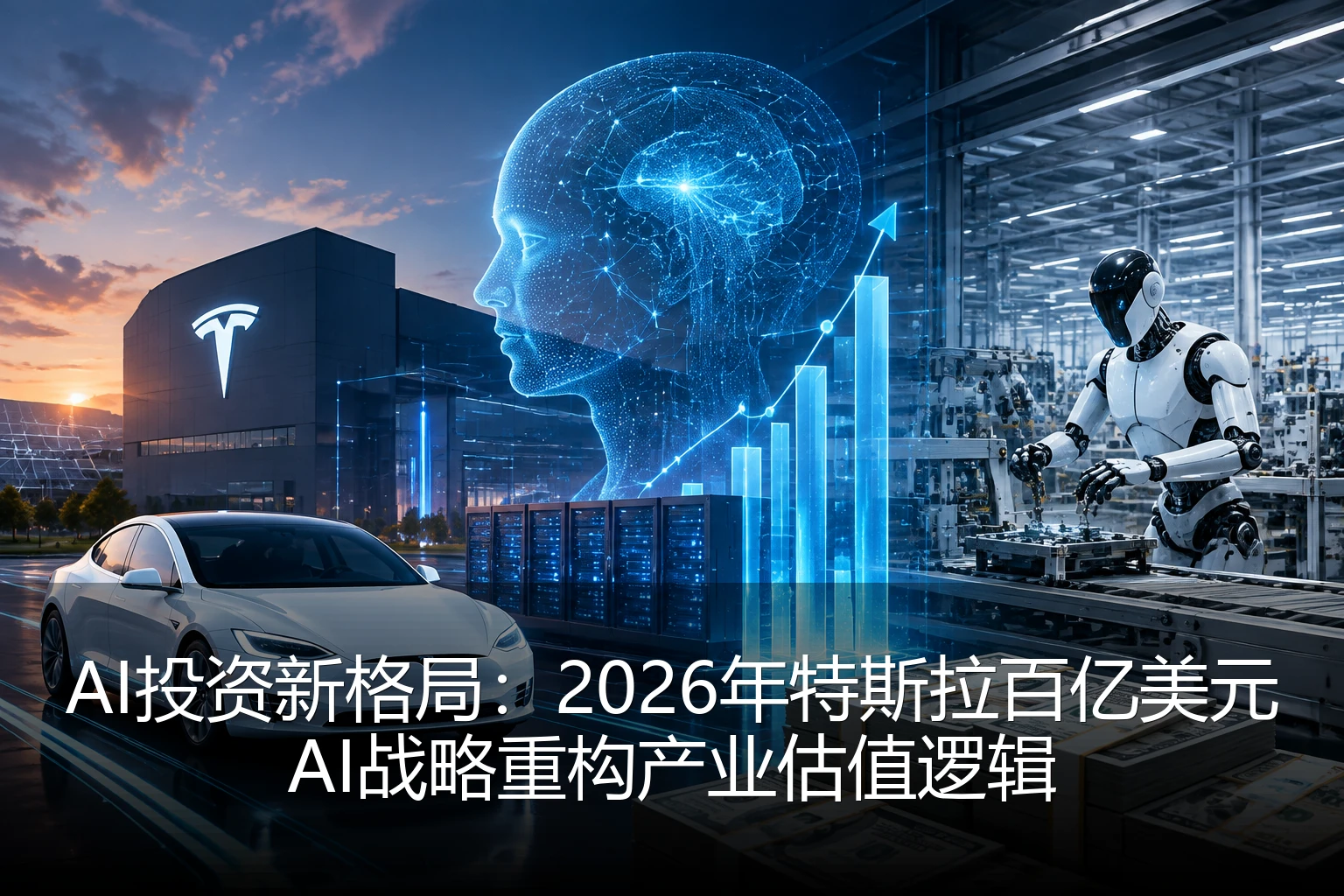
New AI Investment Landscape: Tesla's $10 Billion AI Strategy in 2026 Restructures Industry Valuation Logic
\n\nAugust 2026, Tesla once again demonstrated its ambition and strategic vision in the field of artificial intelligence. As global AI capital expenditure peaks, Tesla is redefining industry valuation logic through billion-dollar-level AI investments, shifting from traditional computing power arms race to embodied mass production. This strategic shift will not only reshape Tesla's own valuation system but will also profoundly affect the entire AI industry's investment paradigm and business logic.
\n\nStrategic Shift: From Computing Power Stacking to Embodied Mass Production
\n\nThe core of Tesla's 2026 AI investment strategy lies in shifting from pure computing power stacking to embodied mass production, marking a new stage in Tesla's AI strategy. According to the latest disclosed capital allocation data, Tesla has shifted about 40% of its AI budget from Dojo supercomputer R&D to mass production and commercialization of Optimus humanoid robots, a proportion that was only 15% in 2025.
\n\n"Tesla is transforming from an 'AI infrastructure provider' to an 'AI product manufacturer,'" noted a senior analyst from Tesla's AI business division. "This shift not only means Tesla's AI strategy is more diversified but also reflects the market's reassessment of AI commercialization paths."
\n\nIn the autonomous driving sector, Tesla is accelerating the implementation of FSD (Full Self-Driving) technology global licensing agreements. By Q3 2026, Tesla has reached technology licensing agreements with multiple automobile manufacturers in Europe and Asia, which will bring billions of dollars in recurring revenue for Tesla while accelerating the construction of the FSD data ecosystem.
\n\nNew Capital Allocation Paradigm: Computing Power as Asset, Data as Finance
\n\nTesla's 2026 AI capital allocation shows obvious characteristics of "computing power assetization." The Dojo supercomputer is no longer just seen as a R&D tool but is beginning to achieve securitization of computing power assets through REIT (Real Estate Investment Trust) model. This innovative move enables Tesla to convert massive computing power investments into tradable financial assets, significantly improving capital efficiency.
\n\n"Tesla is building a 'computing power-data-finance' closed-loop ecosystem," said financial analysts. "Through Dojo computing power REITization, Tesla can not only recover some R&D investments but also obtain continuous income streams, a model that is reshaping the valuation logic of AI infrastructure."
\n\nMeanwhile, Tesla is exploring the financialization path of FSD data assets. By building a dynamic pricing derivative pool based on FSD driving data, Tesla is transforming intelligent driving data into tradable financial assets. This innovation not only opens up new revenue sources for Tesla but also provides a model for the entire industry's data assetization.
\n\nIndustry Valuation Restructuring: From Hardware Value to Software and Services
\n\nThe deepening of Tesla's AI investment strategy is driving a fundamental transformation in the automotive industry's valuation logic. Traditional automakers' valuations are mainly based on hardware sales and manufacturing capabilities, while Tesla is promoting the industry's shift to a "hardware+software+service" comprehensive value model through its AI strategy.
\n\n"Tesla is redefining the value composition of automotive companies," said industry analysts. "In Tesla's valuation model, software and service revenue has increased from less than 5% in 2020 to about 30% in 2026, a shift that is being recognized by Wall Street and reflected in Tesla's market performance."
\n\nSpecifically, Tesla has built a diversified revenue structure through FSD subscription services, software licensing agreements, and data monetization. This model not only increases Tesla's gross margin (software business gross margin reaches 80%, much higher than 25% for automotive business) but also enhances the company's anti-cyclicality and cash flow stability.
\n\nInvestment Efficiency Evaluation: From Scale to Return on Investment
\n\nAs AI investment continues to expand, Tesla is focusing more on evaluating and optimizing investment efficiency. In Q3 2026, Tesla introduced a new AI investment evaluation system that combines traditional R&D investment indicators with return on investment (ROI), emphasizing the commercial value and financial returns of AI investments.
\n\n"Tesla is shifting from 'AI investment competition' to 'AI value competition,'" said financial analysts. "This shift means Tesla's AI investments will focus more on commercialization paths and capital efficiency rather than just technological leadership."
\n\nData shows that Tesla's AI capital return rate in Q3 2026 has increased to about 35%, a significant improvement from 22% in 2025. This improvement is mainly due to the rapid growth of FSD licensing revenue and the continuous decline in Optimus robot prototype costs. Tesla expects that by 2027, its AI business capital return rate may exceed 50%.
\n\nChallenges and Opportunities: Risks and Opportunities in the New AI Investment Landscape
\n\nDespite significant progress in Tesla's AI investment strategy, it still faces many challenges. First, global AI talent competition is becoming increasingly fierce, and Tesla needs to continuously invest significant resources to attract and retain top AI talent. Second, the rapid iteration of AI technology makes R&D investments face high depreciation risks. Additionally, regulatory uncertainty also brings challenges to AI commercialization.
\n\nHowever, challenges also bring huge opportunities. As Tesla's AI ecosystem continues to improve, the company is expected to build strong moats in multiple fields such as autonomous driving, robotics, and energy management. At the same time, Tesla's open and cooperative AI technology strategy will bring more synergies and ecosystem value.
\n\n"Tesla's AI investment is not only about its own development but will also affect the direction of the entire AI industry," said industry experts. "Tesla's practice is proving that large-scale AI investment can coexist with commercial success, providing valuable experience for other companies."
\n\nInvestor Insights: Grasping the New AI Investment Paradigm
\n\nFor investors, Tesla's AI investment strategy shift provides important insights. First, investors need to reassess the value logic of AI companies, shifting from focusing solely on technical indicators to emphasizing commercialization and capital efficiency. Second, AI company valuations should focus more on the value of the ecosystem and data assets they build, rather than just hardware sales.
\n\n"Tesla's case shows that AI investment has entered the 'value creation' stage from the 'burning money for growth' stage," said investment advisors. "Investors should pay more attention to AI companies' business models, revenue structures, and capital return capabilities, not just technological leadership."
\n\nLooking ahead, Tesla's AI investment strategy will continue to deepen. By the end of 2026, Tesla is expected to have invested more than $100 billion in the AI field. This large-scale investment will not only drive Tesla's own technological innovation and commercial success but will also lead the entire AI industry into a new development stage, restructuring industry valuation logic and creating greater economic and social value.
\n\nIn the global AI investment boom, Tesla's strategic choices and practical experience will undoubtedly provide important references for the industry. As AI technology continues to mature and commercialization paths become clearer, Tesla's AI investment story may just be beginning, and its future development deserves continued attention.