AI Business Separately Listed for First Time, Market Eyes FSD Licensing Fees
August 2, 2026 – As Tesla's Q2 earnings release countdown begins, global investors are focused on the results due after market close on August 5. According to several Wall Street investment banks, the biggest highlight of this report is not vehicle deliveries, but whether FSD (Full Self-Driving) licensing revenue will be disclosed as an independent business line for the first time and surpass the $1 billion quarterly mark. This signals Tesla's accelerating transformation from an electric vehicle manufacturer to an AI platform company, fundamentally changing its financial narrative.
According to Goldman Sachs' latest report, Tesla delivered over 150,000 FSD software licenses to traditional automakers like Ford and GM in Q2 2026. At a licensing fee of $7,000 per vehicle, this alone could generate $1.05 billion in revenue. Analysts note that this revenue stream has a gross margin exceeding 90%, significantly boosting overall profitability. Morgan Stanley analyst Adam Jonas even calls the FSD licensing business "Tesla's AWS moment," predicting it could become the company's largest profit source before 2030.
Optimus Production Begins, Capital Spending and Cost Tensions Intensify
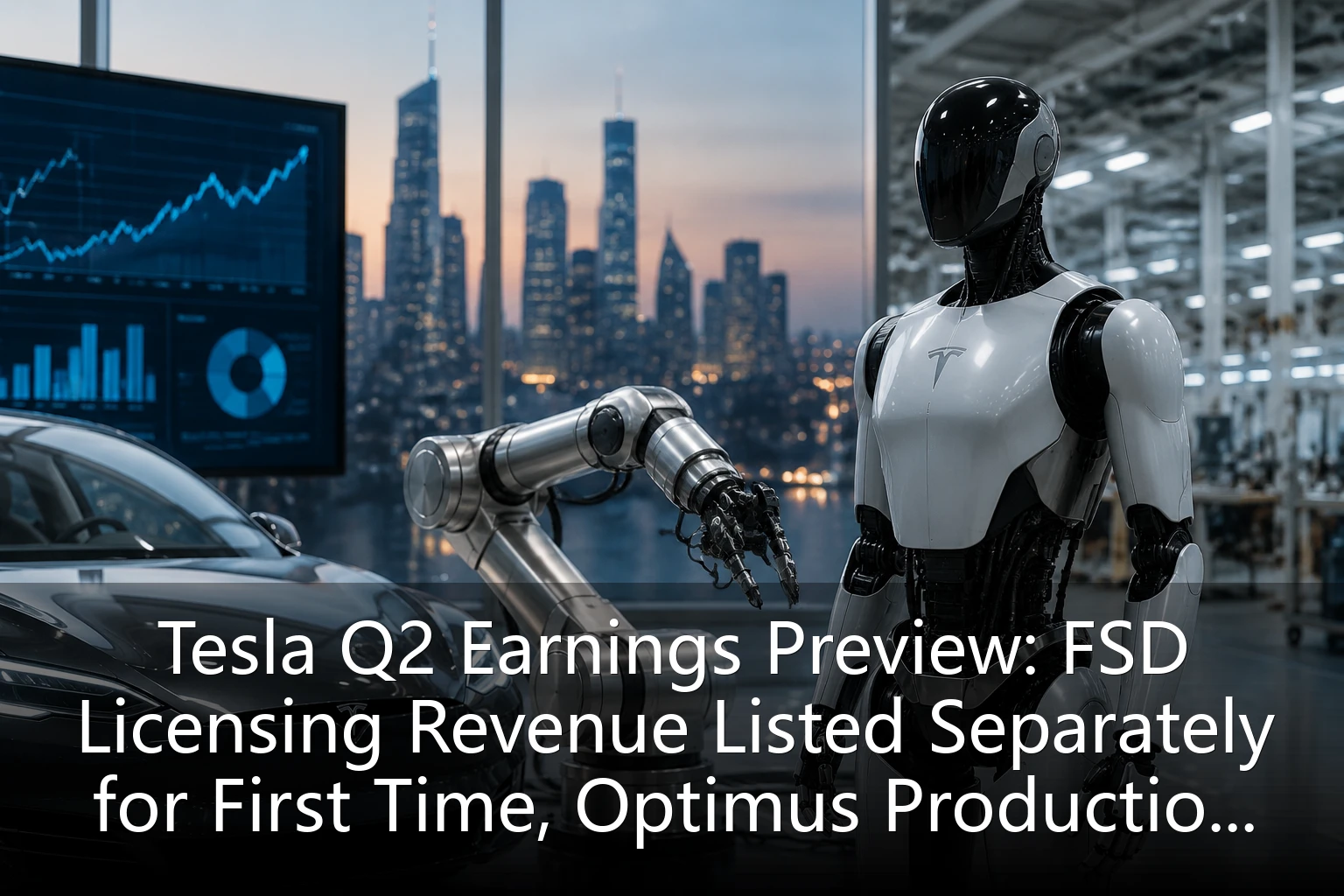
Contrasting with the optimistic FSD outlook, the production cost of the Optimus humanoid robot will be another major suspense in this quarter's earnings. Tesla's Optimus production line in Austin, Texas, officially started production in May this year, ramping up to a monthly capacity of 1,000 units. However, supply chain sources indicate the bill of materials for a single Optimus unit remains as high as $45,000, far exceeding Musk's previously set target of $20,000. This has caused AI-related capital expenditures to surge in Q2, expected to reach $2.8 billion, a 60% year-over-year increase.
Market concerns center on whether initial Optimus production losses could drag down the company's overall gross margin, potentially slipping from 18.5% in Q1 to around 17%. However, long-term investors remain optimistic, believing that once Optimus achieves economies of scale, costs will drop significantly, potentially falling below $25,000 by 2027, unlocking a trillion-dollar market. Tesla's continued investment in AI infrastructure—including the expansion of the Dojo supercomputer and the purchase of 100,000 H100 chips—is also seen as key to supporting the dual-engine drive of FSD and Optimus.
Revenue Forecast Exceeds Expectations, AI Share Continues to Climb
Based on multiple institutional forecasts, Tesla's total Q2 revenue is expected to reach $27.8 billion, a year-over-year increase of about 12%, higher than the market's previous expectation of $26.8 billion. Automotive revenue is estimated at approximately $21 billion, energy business revenue at about $1.8 billion, and the "AI & Services" segment, including FSD licensing, Optimus sales, and AI cloud services, is expected to contribute around $5 billion, accounting for nearly 20% for the first time. This structural shift is reshaping Tesla's valuation framework.
ARK Invest's valuation model updated in July raised Tesla's 2030 target price to $3,000 (split-adjusted), based on the core assumption that FSD licensing revenue will grow at an average annual rate of 50%, while Optimus will create an annual market exceeding $1 trillion. However, some analysts warn that Tesla's current P/E ratio has surpassed 100x, and if AI business growth falls short of expectations, the stock price could face significant correction risk.
Capital Strategy Shift: Rumors of Independent AI Unit Financing Resurface
Notably, ahead of the earnings release, rumors have resurfaced that Tesla's AI unit may pursue independent financing. According to sources, Musk is considering introducing strategic investors for the FSD and Optimus businesses before the end of 2026, with a valuation potentially exceeding $80 billion. This capital strategy aims to provide more ample funding for the AI business while unlocking its hidden value. Tesla previously established a $2 billion AI venture fund and partnered with BlackRock to create an AI infrastructure trust. If this independent financing proceeds, it would be Tesla's largest non-vehicle business capital operation in history.
Analysts point out that the benefit of independent financing is that it allows the AI business to receive a clearer valuation, avoiding being dragged down by the cyclicality of the automotive business. The risk, however, is that if FSD and Optimus fail to meet growth expectations, the independently financed business could face greater market pressure. Currently, Tesla CFO Vaibhav Taneja has hinted in multiple earnings calls that the company is exploring "various paths to unlock the value of the AI business."
Market Reaction and Stock Price Trends
As of the close on August 2, Tesla's stock price was $285, up 4.5% for the week, reflecting market optimism for the Q2 earnings. Options market data shows that the implied volatility for Tesla's stock price after the earnings release is as high as 8%, the highest level in nearly a year, indicating a huge divergence between bulls and bears. Bulls are betting that FSD revenue exceeding expectations will push the stock price above the $300 mark, while bears worry about Optimus cost drag and macroeconomic uncertainty.
Overall, Tesla's Q2 earnings will be a critical juncture to test the effectiveness of its AI strategy. The first disclosure of FSD licensing revenue, the actual figures for Optimus production costs, and any new developments regarding the independent financing of the AI unit will all have a profound impact on the stock price. In 2026, as AI capital trends accelerate towards implementation, Tesla stands at a crossroads, transforming from an automotive company into an AI empire.