Tesla’s Next Chapter: From Electric Cars to Physical AI Infrastructure
Keywords: Tesla, Elon Musk, AI5 chip, FSD, Optimus, manufacturing, physical AI, autonomous driving, robotics, semiconductor strategy
Introduction
Elon Musk rarely speaks about only one company, one product, or one timeline. In his recent conversation with Ron Baron, the discussion moved fluidly from Tesla’s manufacturing speed to AI chips, autonomous driving, humanoid robots, semiconductor capacity, and even the future of human civilization. At first glance, it may appear to be another familiar Musk-style interview: ambitious, nonlinear, and filled with bold predictions.
Yet taken together, the remarks reveal something more important than a collection of futuristic claims. They outline Tesla’s next strategic phase. Tesla is no longer positioning itself merely as an electric vehicle maker. It is evolving into a company that aims to build the infrastructure for physical AI—the systems that connect intelligence, hardware, software, manufacturing, and real-world data.
This is the core logic behind Musk’s latest remarks. Cars are one vehicle for this vision. Robots are another. Chips provide the underlying compute. Factories create the physical output. Driving data supplies the training ground. Tesla’s real ambition is to unify these elements into a closed loop capable of continuous self-improvement.
Manufacturing as a Rewritten Physical System
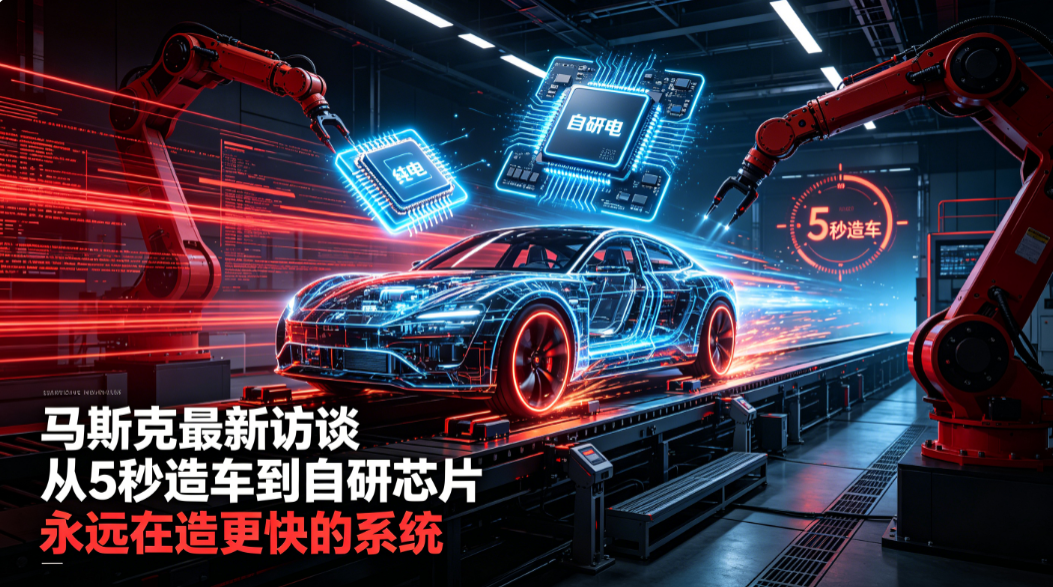
One of the most striking themes in Musk’s thinking is manufacturing efficiency. Tesla’s historical advantage has never been limited to designing attractive electric vehicles. Its deeper strength lies in reimagining how products are made. In the interview, Musk suggested that vehicle output could eventually approach a five-second production cycle, a pace that sounds almost absurd by traditional automotive standards.
But Musk’s reasoning is consistent with his engineering mindset. He approaches manufacturing the way a physicist approaches a system: by identifying bottlenecks, reducing unnecessary movement, and compressing time and space wherever possible. A car is not just a finished product; it is a series of atoms moving through a system. If those atoms can travel through the factory more efficiently, the entire production model changes.
This “bit and atom” perspective is crucial. For Musk, digital systems and physical systems are not separate worlds. They are two versions of the same optimization problem. A factory, in his view, should operate like a giant chip: inputs flow in, processes occur with minimal waste, and outputs emerge as efficiently as possible. That mindset explains why Tesla’s manufacturing model differs so sharply from that of legacy automakers. The goal is not simply to optimize existing workflows, but to redesign the workflow itself.
AI5: The Chip at the Center of Tesla’s Future
If manufacturing is Tesla’s foundation, the AI5 chip is its next strategic center. Musk made clear that he considers the chip critical to Tesla’s future, saying in effect that “the whole company” is tied to it. This is not a minor hardware upgrade. It is a foundational decision about how Tesla will deploy AI in the physical world.
AI5 is intended for Tesla’s next-generation autonomous vehicles and for Optimus, the company’s humanoid robot. Tesla will continue using Nvidia chips for training, but the company wants its own inference chips for vehicles and robots. This distinction matters. Training can happen in centralized data centers, where large GPU clusters are ideal. Inference, however, happens on the edge—in cars and robots—where power consumption, latency, cost, reliability, and scale become decisive.
Here Tesla’s logic becomes highly strategic. For a company that only sells cars, buying standard chips is the rational path. But for a company attempting to deploy autonomous driving and humanoid robots at scale, chip design becomes inseparable from business design. The chip shapes unit economics, product performance, and manufacturing capacity.
Musk’s expectations are unusually aggressive. He has suggested that AI5 could deliver two to three times the performance-per-watt of Nvidia’s solution in inference scenarios, while costing roughly one-tenth as much. Whether or not those targets are fully realized, the direction is clear: Tesla wants a vertically optimized chip built for its own stack, not a generic solution that merely functions well enough.
FSD and the Shift Toward Real-World Autonomy
The AI5 strategy is tightly linked to Tesla’s Full Self-Driving program. Musk said Tesla has accumulated more than 10 billion miles of FSD driving data and argued that the system is already several times safer than human driving in statistical terms. The message is significant: FSD is moving from experimental software toward a system that may soon justify unsupervised autonomy.
The broader autonomous driving industry has long debated technical paths: vision-only versus LiDAR, high-definition maps versus mapless approaches, incremental driver assistance versus end-to-end autonomy. Musk’s view is more direct. If the system becomes safer than the average human driver, the industrial basis for unsupervised deployment begins to exist.
But safety is only one part of the equation. FSD must also pass regulatory scrutiny, manage liability, earn public trust, and perform across different road systems and jurisdictions. That means the challenge is not merely algorithmic. It is systemic. Tesla’s advantage is that it owns the full stack: real-world data, vehicle deployment, chip design, software updates, and the ability to iterate over the air.
The key shift is that autonomous driving is no longer just a software problem. It is a co-design problem involving software, hardware, and real-world deployment.
Optimus and the Expansion of Physical AI
While the interview focused heavily on driving and chips, Optimus may ultimately be the more transformative part of Tesla’s strategy. Without Optimus, AI5 could still be understood as a specialized automotive chip. With Optimus, it becomes a platform for general-purpose robotics.
This is why Musk links autonomous vehicles and humanoid robots so closely. A car is essentially a wheeled robot. Optimus is a humanoid robot operating in a far less structured environment. Both require perception, decision-making, and action in the physical world. The difference is that Optimus must work in factories, homes, and other complex settings where tasks are less predictable and more interactive.
That distinction matters because Tesla’s long-term ambition extends beyond transportation. If FSD is the first path into physical AI, Optimus is the second. FSD changes how machines move through roads. Optimus changes how machines participate in labor. Together, they point to a future in which Tesla does not merely sell vehicles, but sells automation itself.
The Bigger Strategic Signal
Musk also raised the possibility that if external semiconductor capacity cannot keep pace, Tesla may need to consider deeper involvement in chip manufacturing or even a dedicated fab strategy. This does not necessarily mean Tesla will replicate a company like TSMC. The technical and capital requirements are enormous. But the signal is unmistakable: chip supply can no longer be treated as a procurement issue. It is a strategic constraint.
That insight reflects a broader industrial shift. In the AI era, the bottleneck is moving away from traditional manufacturing assets and toward compute, inference chips, and data systems. For Tesla, the competition is no longer just about building better cars. It is about controlling the infrastructure that allows intelligent machines to operate in the real world.
This is also what makes Musk’s vision so influential. He does not separate product development from civilization-scale narratives. He uses the language of the future—abundance, autonomy, intelligence, and human expansion—to frame engineering problems in a way that attracts capital, talent, and urgency.
Conclusion
Tesla’s direction is becoming increasingly clear. It is transitioning from an electric vehicle company into a physical AI company built around manufacturing, autonomous driving, robotics, and proprietary compute. The vehicle remains important, but it is now only one part of a much larger system.
The strategic significance of AI5, FSD, and Optimus lies in their convergence. Together they form a loop: data trains models, chips run models, factories produce hardware, and products generate more data. If Tesla succeeds, it will not simply own a car platform. It will own a scalable system for intelligence in the physical world.
That is the deeper meaning of Musk’s interview with Ron Baron. The subject was not just Tesla’s next product cycle. It was Tesla’s attempt to define the next industrial architecture.