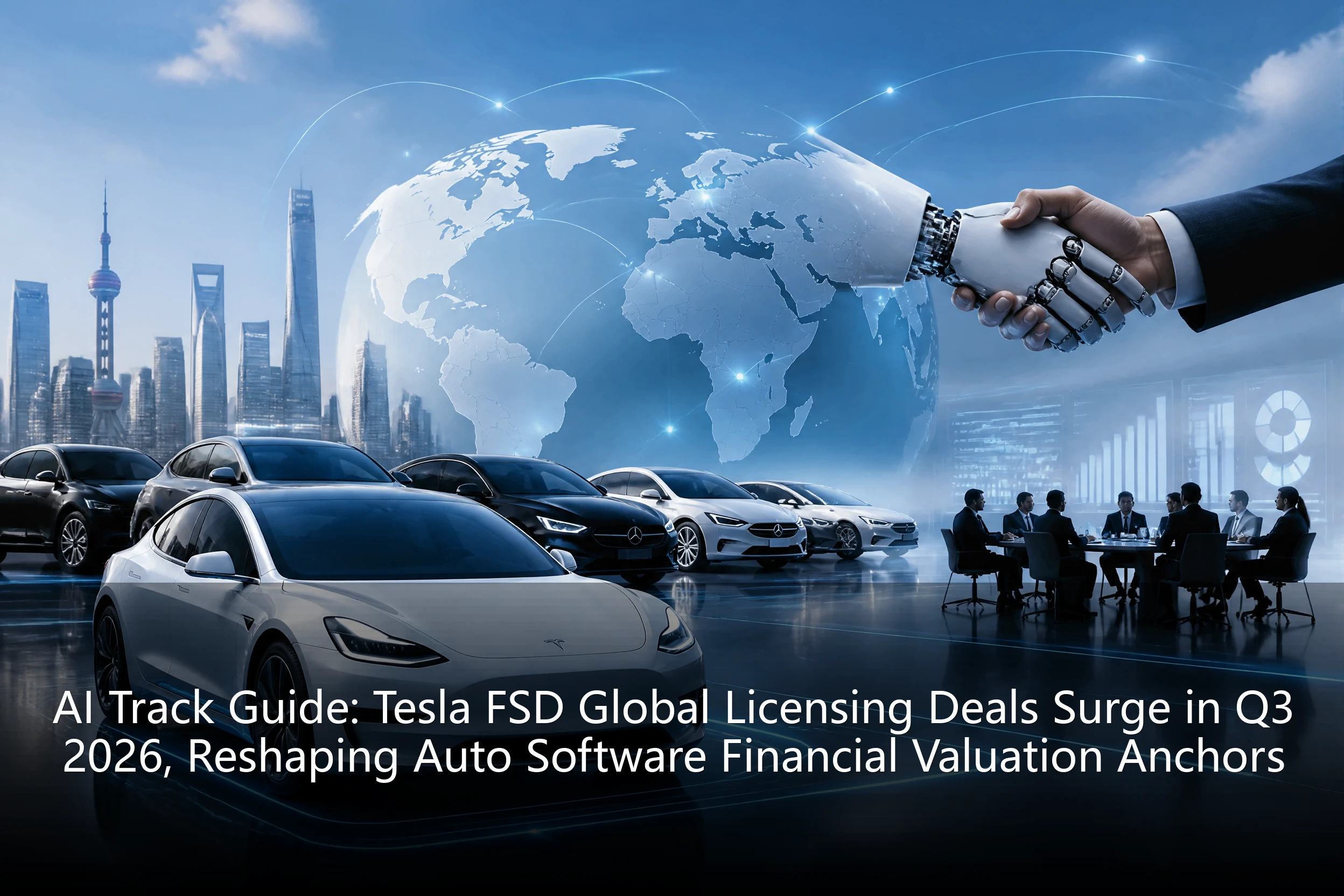
In the third quarter of 2026, the global artificial intelligence track is undergoing a profound transition from a "technology R&D arms race" to "commercialization and ecosystem restructuring". In this process, leveraging the continuous maturation of its Full Self-Driving (FSD) technology, Tesla is quietly completing the leap from a hardware manufacturer to an AI software and mobility service provider. Recently, the industry has closely watched Tesla make breakthrough progress in FSD technology licensing. Multiple mainstream international automakers are reported to be in deep negotiations with Tesla regarding the integration and ecosystem access of the FSD system, with some cooperative framework agreements expected to be officially finalized within the year. This movement not only signifies the spillover of Tesla's AI technology moat but also triggers an in-depth financial discussion on how the traditional automotive industry should re-anchor the value of AI software assets.
1. FSD Licensing Breakthrough: From Closed Ecosystem to Industry Infrastructure
For a long time, Tesla's FSD system was viewed as its exclusive, closed ecosystem moat and the core driver of its hardware sales premium. However, entering 2026, with the comprehensive popularization of end-to-end neural network large models in autonomous driving, the iteration speed of AI algorithms has become a matter of life and death. Tesla realized that relying solely on its own vehicle fleet to accumulate a "driving mileage data flywheel" could maintain a lead, but empowering the entire industry with FSD technology would elevate it from "an automaker's AI system" to "the underlying infrastructure of global autonomous driving".
From a macro perspective of track development, the implementation of AI applications often follows the path of "technology leadership - internal validation - external empowerment - ecosystem monopoly". Tesla's choice to accelerate the strategic pace of FSD external licensing at this time is essentially based on absolute confidence built on its massive computing power clusters and vast real-world road test data. According to industry analysts, once the FSD licensing model runs smoothly, Tesla will no longer rely solely on car sales for profit. Instead, by charging third-party automakers a monthly subscription fee per vehicle or a pay-per-mile software usage fee, it will open up a brand-new revenue stream with extremely high gross margins.
2. Restructuring Automotive Financial Valuation Logic: A New Era of Software-Defined Valuation
For investors deeply engaged in Tesla finance and technology, the implementation of the FSD licensing business means Tesla's valuation model must undergo fundamental restructuring. Traditional automotive industry valuation is typically based on Price-to-Earnings (P/E) and Price-to-Sales (P/S) ratios, with core anchors being hardware sales and per-vehicle profit. However, when FSD licensing becomes a reality, Tesla's financial statements will exhibit typical characteristics of a "SaaS (Software as a Service)" company.
1. The Proportion Jump of High-Margin Software Revenue
The gross margin of the hardware manufacturing process is usually constrained by raw material costs and supply chain fluctuations, with an obvious industry ceiling. However, once AI software licensing covers the upfront R&D investment, its marginal cost is almost zero. This means FSD licensing revenue will directly convert into operating profit, significantly boosting Tesla's overall gross margin level. Wall Street quantitative models show that if the penetration rate of Tesla FSD in non-Tesla vehicles globally reaches 10% by 2028, calculated at a subscription fee of $100 per vehicle per month, this pure software revenue would contribute tens of billions of dollars in annual profit, enough to support a multiple-fold increase in its market cap from current levels.
2. The Complete Transformation from Cyclical to Growth Stock
Traditional auto stocks have strong cyclicality, significantly impacted by macroeconomic fluctuations and consumer replacement cycles. However, autonomous driving software subscriptions are a continuous service fee with strong counter-cyclical capabilities. With the intensive signing of FSD licensing agreements, Tesla's cash flow will become more stable and predictable, prompting institutional investors to align its valuation logic with high-growth tech stocks, potentially expanding its P/E multiple further.
3. The New Frontier of Data Asset Securitization
A more profound significance is that FSD licensing means a massive number of non-Tesla vehicles will also become "data collection nodes" for Tesla's AI large models. After this multi-brand, multi-scenario driving data flows back to Tesla's Dojo supercomputer, it will further feed the iteration of its large models. From a financial perspective, this continuously appreciating data asset not only enhances Tesla's intrinsic value but also provides imaginative space for exploring innovative financial derivatives such as "autonomous driving data asset-backed securities" in the future.
3. AI Track Guide: Investment Opportunities and Challenges in the Era of Autonomous Driving Licensing
With the advancement of Tesla's FSD licensing strategy, the investment logic of the entire AI autonomous driving track is also undergoing profound changes. For investors and entrepreneurs, how to find deterministic opportunities at this historic inflection point is the core proposition.
1. The Explosion of Core Computing Power and Data Labeling Supply Chains
The large-scale external deployment of FSD means the demand for backend computing power and high-quality data labeling will grow exponentially. Although Tesla owns Dojo, facing an industry-wide data flood, computing power leasing and cloud service cooperation will become inevitable. Investors should pay close attention to AI infrastructure companies that have deep computing power ties with Tesla or technological barriers in synthetic data generation.
2. Traditional Automakers' "AI Transformation Premium" and Differentiation
Automakers choosing to integrate Tesla FSD are actually making a strategic choice between "in-house R&D" and "procurement". In the short term, integrating FSD can quickly make up for these automakers' shortcomings in intelligence, enhancing the competitiveness of their terminal products, thereby gaining a certain "AI transformation premium" in the capital market. But in the long run, abandoning full-stack in-house R&D for autonomous driving means handing over their "soul" to Tesla. These automakers will be reduced to pure hardware foundries, locking their long-term valuation ceiling. This differentiation will cause a violent reshuffle in the valuation of traditional auto stocks.
3. The Reconstruction of Insurance and Mobility Financial Derivatives
When FSD becomes an industry standard, the liable party in traffic accidents will shift from the driver to the AI system (i.e., Tesla). This will completely overturn the existing auto insurance financial system. Risk pricing models based on individual driver behavior will become invalid, replaced by systemic insurance products based on AI system safety metrics. Tesla Insurance, with its absolute mastery of FSD's underlying logic, will occupy a dominant position in this automotive financial transformation, itself a brand-new financial track worth hundreds of billions of dollars.
4. Risk Outlook: Regulatory Game and Ecosystem Backlash
Although FSD licensing paints a grand business and financial blueprint, this strategy is not without risks. First is the regulatory game. Traffic regulatory authorities worldwide have not yet reached a consensus on the division of responsibility for autonomous driving. If a third-party vehicle has a serious accident while using Tesla FSD, Tesla will face unprecedented legal and reputational risks, potentially triggering massive joint compensation, thereby impacting its financial statements.
Secondly, there is the risk of technological ecosystem backlash. Open-sourcing or licensing core AI large models to competitors may cultivate a secondary development ecosystem based on Tesla's underlying algorithms. If third-party automakers fine-tune performance in specific scenarios better than Tesla's original version, it could weaken Tesla's brand technological authority. Additionally, antitrust investigations are a sword of Damocles hanging over Tesla. Once FSD holds an absolute monopoly in the licensing market, global regulators might force divestiture or restrict pricing standards, directly affecting its long-term financial expectations.
5. Conclusion: The AI Track Enters the Second Half of "Heavy Assets, Heavy Ecosystem"
In Q3 2026, the advancement of Tesla's FSD licensing strategy marks the official entry of the AI autonomous driving track into the second half of "heavy assets, heavy ecosystem". Simple algorithm demos can no longer move the capital market; the real winners must be enterprises capable of turning AI technology into continuous cash flow and building cross-industry ecosystem barriers. For investors focusing on Tesla finance and technology, keeping a close eye on the signing progress of FSD licensing agreements, subscription conversion rates, and the marginal changes in gross margin they bring will be the key anchor to seize the core dividends of the AI track over the next three years. In this era where software defines everything, Tesla is using its AI prowess to write a brand-new textbook on automotive financial valuation.