2026 AI Investment Paradigm Shift: From Computing Arms Race to Commercial Loop Monetization
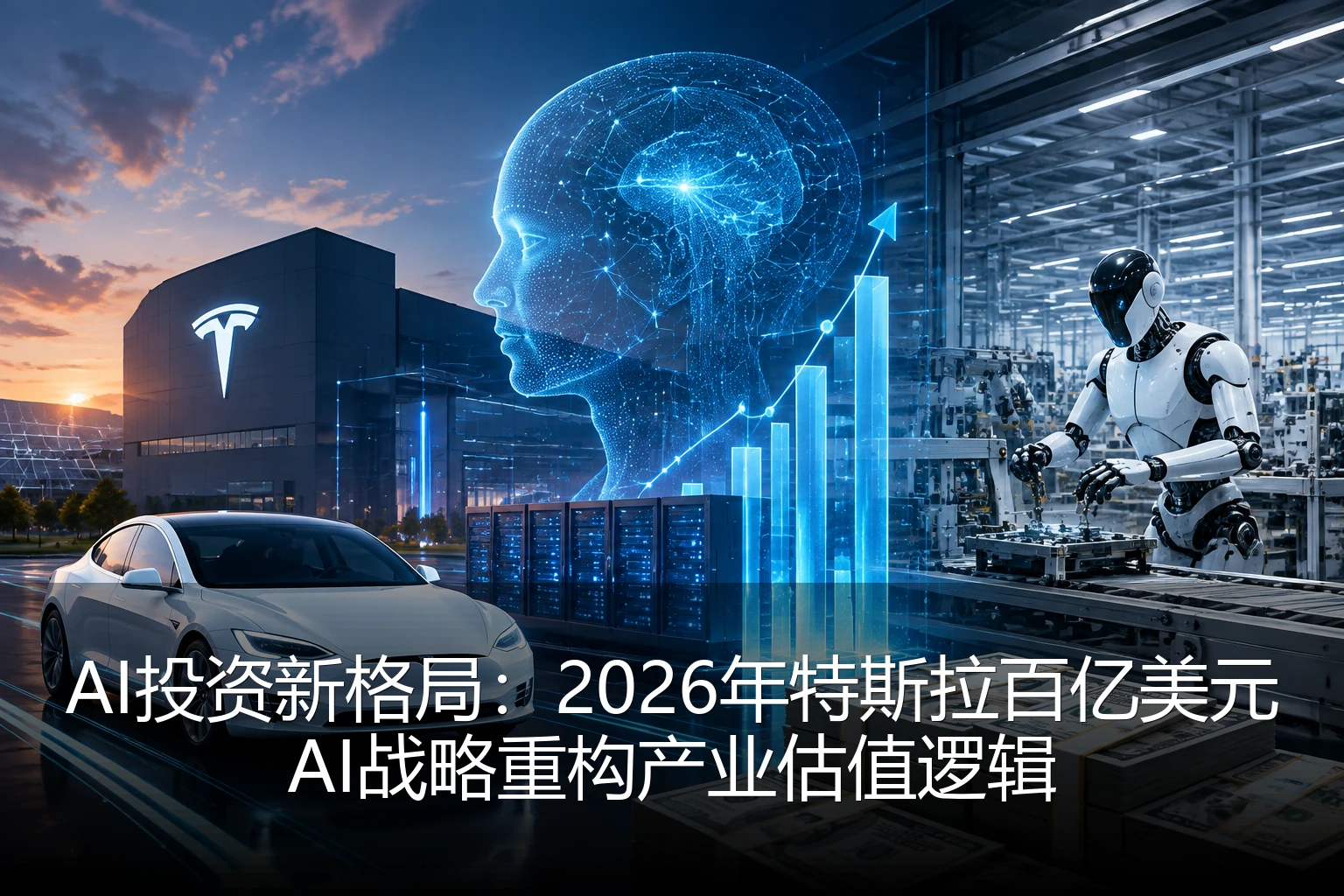
As the third quarter of 2026 progresses, profound structural changes are occurring in the investment logic of the global AI field. The arms race centered on computing power stacking over the past two years is gradually fading, and capital markets are focusing more on the commercial landing capability of AI technology and cash flow generation efficiency. Against this macro backdrop, Tesla, as the only global tech giant with a complete layout in autonomous driving, humanoid robots, and energy management, has seen the evolution of its AI strategy become a focal point for Wall Street.
Unlike pure software model companies, Tesla's AI layout has a strong reliance on real industries. From the computing power foundation of the Dojo supercomputer, to the end-to-end large model of FSD (Full Self-Driving), to the mass production ramp-up of the Optimus humanoid robot, Tesla is building an unprecedented software-hardware integrated AI ecosystem. For investors, understanding how this ecosystem shifts from capital input to capital output—that is, how to form a "capital loop"—is key to grasping the elasticity of Tesla's future valuation.
Restructuring Wall Street's Valuation Logic
Entering 2026, financial institutions' valuation models for Tesla are no longer limited to the traditional automotive manufacturing PE (Price-to-Earnings) multiple. More and more analysis reports are adopting SOTP (Sum-of-the-Parts), splitting it into three major segments: EV business, energy business, and AI/robotics business. Among them, the valuation weight of the AI segment has risen significantly, driven primarily by the increasing visibility of its commercial loop.
The market generally believes that the core moat of Tesla's AI business lies in its unique "Data-Computing-Application" flywheel effect. This closed-loop effect not only reduces the marginal cost of external computing procurement but also feeds back model iteration through applications in real scenarios, thereby far surpassing competitors in capital efficiency.
Dojo Supercomputer's Commercial Breakthrough: From Internal Engine to External Output
For a long time, the Dojo supercomputer was seen as an internal engine for Tesla's FSD training. However, with the further expansion of Dojo's computing scale in 2026 and the maturation of the D1 chip ecosystem, this capital-intensive asset is gradually transforming into a profit center.
Profit Model of Computing as a Service (DaaS)
Tesla is actively exploring the external leasing service of Dojo computing power, namely Dojo as a Service (DaaS). This strategic shift is significant. At a time when AI training demand is surging, high-quality, low-cost computing resources are extremely scarce. Leveraging its self-developed chips and vertically integrated energy advantages, Tesla is poised to provide more cost-effective computing solutions than general cloud service providers.
Industry analysis points out that Tesla providing computing services externally can not only amortize the huge depreciation costs of infrastructure but also create high-margin recurring revenue. This "picks and shovels" business model, similar to the contribution of Amazon AWS to Amazon's overall market cap, is expected to open up a new valuation space for Tesla. Especially for enterprises needing to process massive video data, Tesla's optimization experience in the video training field possesses extremely high irreplaceability.
Differentiated Competitive Path Against Nvidia
Although Nvidia occupies a dominant position in the general GPU market, Tesla's advantages in vertical integration in specific fields are emerging. The Dojo architecture is designed specifically to process visual data required for autonomous driving, showing unique advantages in energy efficiency ratios and specific task throughput. In 2026, with the discovery of more non-automotive application scenarios, such as medical image analysis and industrial video inspection, the Dojo computing ecosystem is breaking boundaries, forming a complex landscape of complementarity and competition with Nvidia.
FSD and Robotaxi: The Cash Flow Qualitative Change in Autonomous Driving
In Tesla's AI landscape, FSD is not only the jewel in the crown of technology but also the core source of future cash flow. In 2026, with the widespread rollout of FSD v13 and the maturation of the end-to-end neural network architecture, the reliability and intervention rate of the autonomous driving system reached new milestones.
Decreasing Marginal Costs Brought by End-to-End Large Models
Tesla's pure vision approach and end-to-end large model route proved their cost advantage in 2026. Unlike multi-sensor fusion schemes relying on high-definition maps and LiDAR, Tesla's solution has an overwhelming advantage in hardware costs, laying the foundation for large-scale commercialization. More importantly, as the fleet size expands, the marginal cost of data collection approaches zero, while model performance improves exponentially with the increase in data volume. This positive cycle of "more data, lower cost, better experience" constitutes an extremely strong commercial barrier.
Asset Securitization Potential of the Robotaxi Network
The implementation of the Robotaxi (autonomous taxi) business is seen as a key step in Tesla's transformation from selling cars to selling services. In 2026, pilot operation data of Robotaxi in North America and parts of Asia showed that its vehicle utilization rate far exceeded that of traditional ride-hailing, and operating costs were significantly reduced.
A deeper impact lies in the reconstruction of financial attributes. Tesla is exploring the securitization of Robotaxi fleet assets, packaging future fare revenue streams into financial products by establishing Special Purpose Vehicles (SPVs). This not only provides Tesla with a third financing channel besides equity and debt but also greatly improves asset turnover. Wall Street analysts generally believe that once the Robotaxi business is fully rolled out, it will transform Tesla from a low-turnover manufacturing company into a high-turnover internet platform company.
Optimus Humanoid Robot: Labor Arbitrage in the Real Economy
If autonomous driving is Tesla's extension into the virtual world, then the Optimus humanoid robot is its ambition to conquer the physical world. In 2026, the large-scale deployment of Optimus in Tesla's own factories marked the official entry of this product into the commercial verification stage.
Supply Chain Integration and Mass Production Cost Reduction Curve
The reason Optimus has caused a sensation in the capital market lies in its amazing expectations for mass production cost reduction. Leveraging the economies of scale of the automotive manufacturing supply chain, Tesla has compressed the cost of core robot components to one-tenth or less of traditional industrial robots. This ultimate cost control capability makes the substitution of humanoid robots in labor-intensive industries such as manufacturing and logistics economically feasible.
From an investment perspective, Optimus is not just a new product, but a carrier for the spillover of Tesla's AI technology. It reuses FSD's perception algorithms, Dojo's training computing power, and battery management technology. This technology reuse greatly amortizes R&D costs, significantly improving the Return on Investment (ROI) of individual projects.
Energy Synergy: The Last Piece of the Puzzle for an AI Giant
Today, with AI computing power demand growing exponentially, energy supply has become a bottleneck restricting development. Tesla's deep accumulation in energy storage and photovoltaics gives it a unique energy moat in the AI race.
In 2026, Tesla began deploying Megapack energy storage systems in some data centers, combined with solar power generation, to build integrated green computing centers for "generation, storage, charging, and computing." This not only effectively reduces the electricity costs of computing operations but also avoids the downtime risks caused by grid fluctuations. As the proportion of energy costs in total computing operating costs continues to climb, this energy synergy capability is transforming into tangible profit advantages.
Conclusion: Revaluation of Tesla's AI Ecosystem Investment Value
In summary, Tesla in 2026 is no longer a simple electric vehicle manufacturer, but an AI super-complex integrating computing power, algorithms, data, energy, and robotics. From the commercial monetization of Dojo cloud services, to the cash flow explosion of the Robotaxi network, to the reshaping of the real economy by Optimus, Tesla is building a massive and efficient capital loop.
For investors, understanding the logic of this loop is crucial. This means that the metric for evaluating Tesla is no longer quarterly deliveries, but the marginal profit margin of the AI business, the proportion of recurring revenue, and asset turnover efficiency. In this era where AI technology moves from "cloud" to "edge" and from "virtual" to "reality," Tesla is redefining the investment paradigm of the AI track with its full-stack self-research capabilities. In the future, as each node of this loop is connected one by one, Tesla is expected to become the world's first company to achieve the commercial landing of AGI (Artificial General Intelligence), and its long-term investment value will also be continuously revalued by the market.