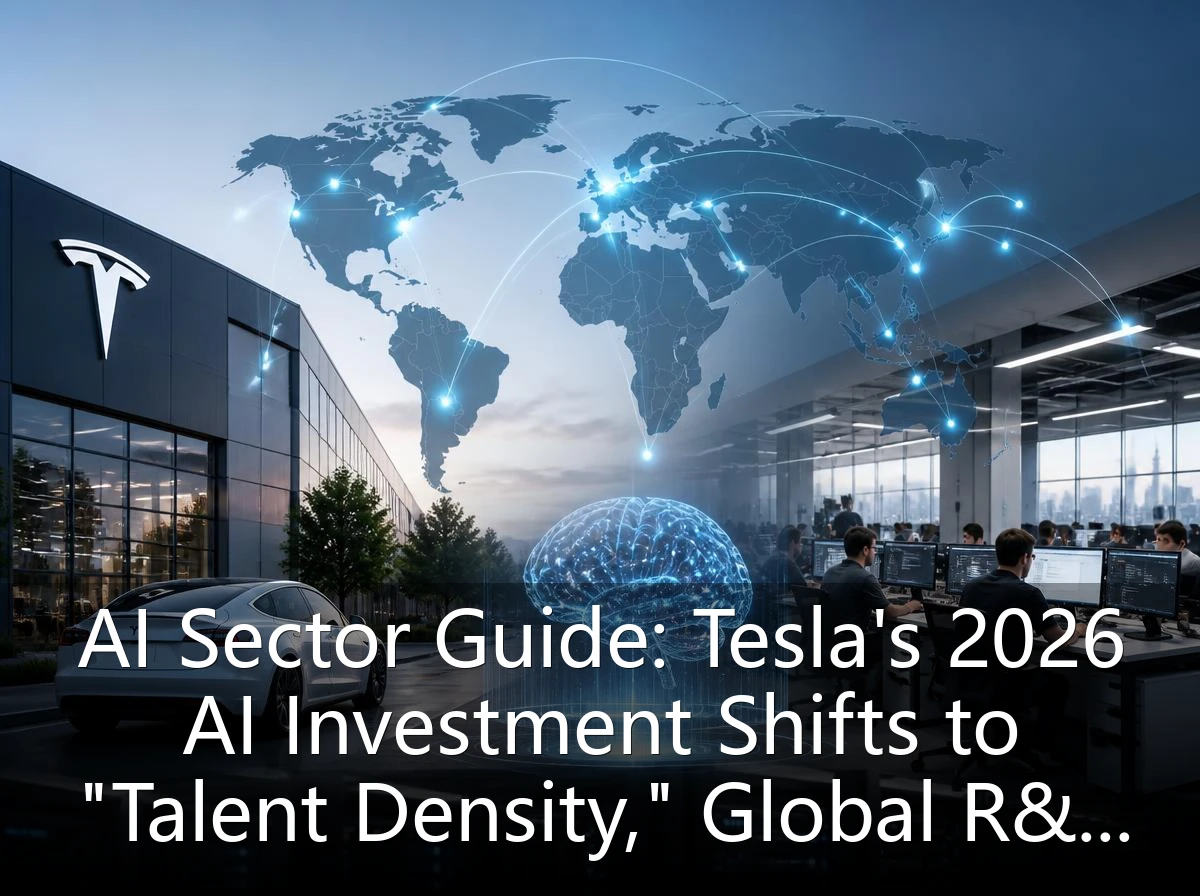
Introduction: The Next Battle After Computing Power — Talent Density
In August 2026, as global AI infrastructure construction gradually completes, the smoke of the computing power arms race dissipates, replaced by a more hidden yet deadly battle—the war for "talent density." As the leader in the global AI sector, Tesla (Tesla), after years of billions of dollars in computing power investment, is undergoing a profound qualitative change in its investment logic. Latest industry observations show Tesla is accelerating adjustments to its AI capital allocation strategy, shifting from simple hardware stacking to the absorption and integration of top global AI brains. This strategic shift not only marks the entry of the AI industry into a new stage where "algorithms and talent are decisive," but also provides a brand new anchor point for Wall Street to re-evaluate Tesla's long-term value.
In the past year, although Tesla's capital expenditure (CapEx) has remained high, its flow has quietly changed. Besides continuing to expand the Dojo supercomputer and optimize the Optimus production line, massive funds are flowing into the construction of R&D centers worldwide and compensation incentives for high-end talent. For readers of GPTeslaWiki, understanding this reconstruction from "hard assets" to "soft power" is key to grasping Tesla's future stock price fluctuations and investment opportunities.
Strategic Shift: From "Buying Graphics Cards" to "Buying Brains"
Reviewing 2024 to 2025, Tesla's AI investment strategy mainly revolved around the "computing power moat." By developing the D1 chip in-house and building a massive Dojo computing cluster, Tesla sought to establish an insurmountable barrier at the hardware level. However, entering 2026, with the improvement of open-source large model capabilities and the decline in general computing costs, the advantage of pure computing power is being rapidly diluted. Industry consensus is gradually forming: in a future where computing power is no longer a scarce resource, whoever can utilize computing power more efficiently and train models with greater generalization ability will dominate the market.
This leads to Tesla's latest strategic core—"talent density." Musk emphasized in internal meetings that the output of a top AI engineer might be ten or even a hundred times that of an ordinary engineer. In the fields of end-to-end large models and embodied intelligence, this output gap caused by cognitive differences is further amplified. Therefore, Tesla's current capital allocation is prioritizing "high-density talent teams." This is not just about raising salary packages, but attracting the world's best AI scientists by establishing special funds, equity incentive plans, and providing top-tier research environments.
This shift is reflected in financial statements as a significant rise in R&D expenses, especially expenditures related to "stock-based compensation." For investors, this is no longer a simple cost increase, but a deep investment in the core asset—human capital. Tesla is converting funds into intelligent brains capable of handling billion-parameter models and solving complex real-world interaction problems, an asset that no GPU can replace.
Global Layout: Building a Cross-Time-Zone AI R&D Network
To maximize talent acquisition efficiency, Tesla accelerated the globalization of its AI R&D centers in 2026. Different from the past model of relying solely on California HQ and Austin factory, Tesla is consciously establishing "strongholds" in global AI talent gathering places.
1. European Hub: Deepening Basic Algorithms and Ethics
In Europe, Tesla is increasing investment in London and Paris R&D centers. Europe possesses a deep foundation in basic mathematics and a rigorous academic tradition, especially in reinforcement learning and AI safety. By establishing specialized research institutions in Europe, Tesla can not only avoid some talent flow restrictions caused by geopolitics but also utilize local top university resources to tackle long-tail problems in FSD (Full Self-Driving) algorithms. Additionally, the EU's increasingly strict AI regulatory acts require Tesla to have a team proficient in regulations locally to ensure the compliant landing of its autonomous driving technology.
2. Asia-Pacific Hub: Focusing on Engineering and Data Closed-Loop
In the Asia-Pacific region, besides continuing to consolidate the Shanghai team's advantages in autonomous driving data annotation and localization adaptation, Tesla is setting its sights on India and Southeast Asia. India possesses a massive group of young programmers and a fast-growing AI startup ecosystem. Tesla's layout here aims to build efficient engineering implementation teams to quickly convert Silicon Valley algorithm models into product features. Meanwhile, the complex traffic scenarios in the Asia-Pacific region provide Tesla with extremely valuable data training grounds, feeding back global model iteration through the "data flywheel" effect.
3. North American Dual-Core: Perfect Fusion of Hardware and Software
In North America, Tesla is attempting to build a "Silicon Valley-Austin" dual-core drive model. The Silicon Valley team focuses on frontier exploration, such as next-generation Transformer architectures and generative world models; while the Austin team is closer to hardware manufacturing, focusing on implanting AI algorithms into the physical entities of Optimus robots and Dojo chips. This geographic division allows Tesla to balance scientific research innovation with mass production landing, greatly shortening the path from laboratory to factory.
Financial Perspective: How Talent Capital Reshapes Valuation Models
For financial analysts and investors, Tesla's strategic shift poses a new challenge: how to quantify the contribution of "talent capital" to market capitalization? Traditional DCF (Discounted Cash Flow) models are often based on hardware sales or software subscription numbers, making it difficult to directly capture the non-linear growth potential brought by talent density.
1. New Indicators for R&D Efficiency
Investors are starting to pay attention to the indicator of "output per R&D personnel." With the elitization of Tesla's AI team, the number of patents generated per unit of R&D input, model iteration speed, and feature launch cycles are all significantly optimizing. If Tesla can launch FSD V13 or Optimus Gen 3 with fewer people and in less time, this will directly translate into an improvement in profit margins. Therefore, when building valuation models, analysts should give higher weight to R&D efficiency, rather than just staring at the absolute value of R&D expenses.
2. Talent Retention Rate as a Risk Factor
Talent capital is also a double-edged sword. High-density talent teams face extremely high risks of being poached. OpenAI, Google DeepMind, and various AI startups are all watching covetously. Whether Tesla's equity incentive package design is competitive, and whether its corporate culture is sufficient to retain geeks pursuing the ultimate, have become invisible risk factors affecting the stock price. The market may fluctuate violently due to the departure of core AI scientists, and this "human capital risk" must be included in investment considerations.
3. Appreciation of Intangible Assets
With the spread of the global R&D network, Tesla is accumulating not just code, but cross-regional, cross-cultural engineering collaboration experience and data assets. Although these intangible assets are not directly reflected on the balance sheet, they constitute the foundation of Tesla's long-term competitive barrier. When Wall Street starts to re-evaluate Tesla's "book value," this intellectual property library built by top global brains will become an important driving force for the expansion of the price-to-earnings ratio (P/E).
Industry Interpretation: The "Matthew Effect" Intensifies in the AI Sector
Tesla's move is not an isolated case, but a microcosm of the entire AI industry's development. In the 2026 AI sector, resources are highly concentrated in leading enterprises, presenting a strong "Matthew Effect."
- Survival Dilemma for Startups: As giants use funds to snatch top talent, the financing environment for AI startups becomes increasingly difficult. Salaries of top talent have been bid up to sky-high prices, which startups cannot afford, leading to a drying up of innovation sources. This means that future AI breakthroughs will occur more inside tech giants with strong capital strength, rather than in garage startups.
- Intensified Cross-Border Competition: Tesla's aggressive investment in AI talent has also attracted competition from non-automotive industries. Traditional tech companies, hedge funds, and even biotech giants are competing for the same batch of compound talents who understand algorithms, computing power, and optimization. This cross-border competition further pushes up labor costs, forcing Tesla to provide more attractive visions and compensation packages.
- Application Scenarios Determine Talent Flow: Currently, the most attractive AI talent flow is shifting from simple "large model training" to "embodied intelligence" and "physical world interaction." Because Tesla possesses Robotaxi and Optimus, the two physical scenarios closest to landing, it has become the preferred destination for top talent. This positive loop of "scenario-talent" will further widen the gap between Tesla and competitors in the autonomous driving field.
Investment Advice: Focus on the Premium Brought by "Soft Power"
For investors following Tesla, the investment logic for the second half of 2026 and beyond needs corresponding adjustments:
First, de-emphasize short-term hardware sales fluctuations. In the critical period of AI transformation, short-term fluctuations in vehicle deliveries should not be the sole basis for buy/sell decisions. Investors should pay more attention to news on Tesla's AI talent acquisition, the progress of R&D center expansion, and key algorithm iteration milestones.
Second, value the financial signals of "talent capital". Pay attention to explanations regarding the structure of R&D expenses in financial reports, especially changes in stock-based compensation expenditures. This is often a leading indicator of the company's talent reserve. Meanwhile, pay attention to company executives' expressions on team building and technical barriers during conference calls, as these often foreshadow the product explosiveness of the coming quarters.
Finally, be alert to the risk of valuation logic switching. When the market starts valuing from a "hardware company" to an "AI software/talent company," the volatility of stock prices may increase significantly. Investors need to adapt to this high volatility based on expectations and technological breakthroughs, utilizing the market's overreaction to short-term news to find entry points for long-term holding.
Conclusion: Talent Defines the Future
In August 2026, standing at the crossroads of the AI sector, Tesla proved with practical actions: beyond computing power, there is a higher dimension of competition. By shifting the focus of capital allocation to the construction of a global talent network, Tesla is building an insurmountable moat for itself. For readers of GPTeslaWiki, this is not only an analysis of investment strategy but also a prophecy about the future landscape of tech competition. In the era where AI defines everything, talent density is the new oil, and Tesla is becoming the most active driller in this new oil war.