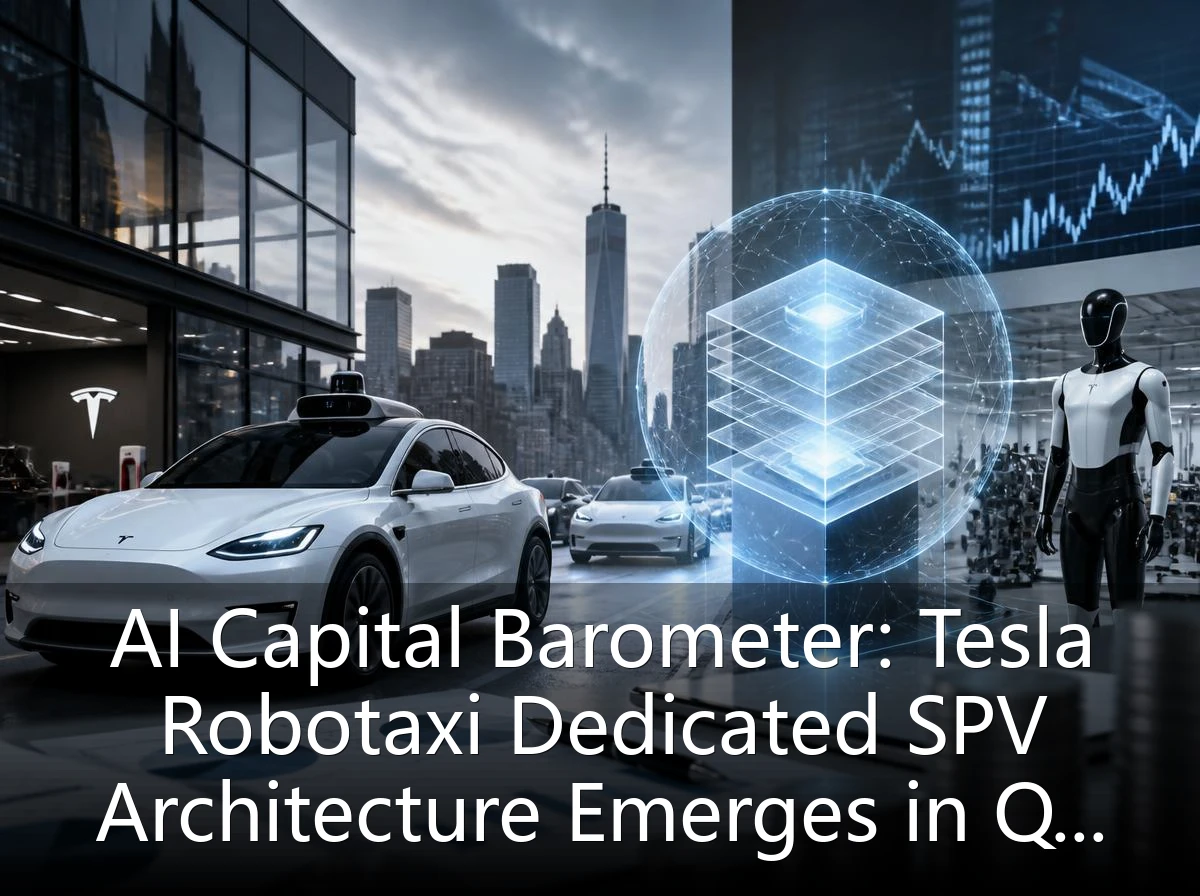
In Q3 2026, global capital markets' focus on Tesla is undergoing a notable shift. From the narrative of a "tens-of-billions AI capex" compute arms race at the beginning of the year, to the mid-year earnings tug-of-war over Optimus mass-production costs and FSD licensing revenue, Wall Street capital flows are now tilting toward a more structural financial engineering topic: the design of a dedicated Special Purpose Vehicle (SPV) architecture behind Tesla Robotaxi commercialization.
Cross-verified by multiple independent sources, Tesla's management is in close discussions with top-tier investment banks and structured finance advisors, intending to build an SPV architecture centered on vehicle assets, data flows, and operating cash flows before Robotaxi officially enters commercial operation. The core purpose of this architecture is not a simple financing tool, but rather to integrate the Robotaxi fleet, FSD driving data interfaces, Optimus maintenance robots, and potentially third-party capacity into an independently valued financial entity through legal asset isolation.
I. Industry Logic Behind the SPV Architecture Emergence
To understand why Tesla is planning the SPV architecture at this moment, we need to revisit several key milestones in Robotaxi commercialization. In the first half of 2026, Tesla completed safety-driver-free Robotaxi road tests in multiple North American cities, and the regulatory compliance framework has gradually become clearer. The market broadly expects Robotaxi to enter small-scale commercial operations from the second half of 2026 through the first half of 2027.
However, Robotaxi's business model differs fundamentally from traditional vehicle sales. Its revenue comes from continuous mobility service fees rather than one-time vehicle sales. This means Tesla needs to prove to capital markets that Robotaxi asset cash flows are predictable, securitizable, and capable of supporting independent debt or equity financing. The SPV architecture is precisely the key tool to address this proposition.
From the historical experience of global industrial capital, the aviation industry has securitized fleet assets through aircraft leasing SPVs, and the real estate industry has packaged holding-property cash flows into REITs. These structural financial innovations have greatly unleashed the valuation potential of underlying assets. If Tesla can place Robotaxi assets into an SPV and introduce external long-term capital through structured financing, it can not only accelerate fleet expansion but also "carve out" these assets from the parent company's balance sheet, releasing financial flexibility on Tesla's main statements.
II. Three-Layer Structure Design of Asset Isolation
Based on currently available public information and industry inference, Tesla's Robotaxi SPV architecture design may present a three-layer structure.
Layer 1: Vehicle Asset Layer
The underlying assets are the Robotaxi operating vehicles themselves. Given that Tesla vehicles feature hardware standardization and OTA-upgradable software, these vehicles are closer to "long-life digital assets" than traditional cars in accounting treatment. This asset attribute makes them more suitable as underlying collateral for SPVs, supporting Asset-Backed Securities (ABS) issuance.
Layer 2: Data and Operations Layer
The middle layer consists of FSD driving data, passenger mobility data, and pricing algorithm data generated during Robotaxi operations. Valuing such data assets is challenging, but they have clear derivative revenue potential in dynamic insurance pricing, urban planning licensing, and ad monetization. Tesla may inject these intangible assets into the SPV in the form of "future revenue sharing" through data usage rights licensing agreements.
Layer 3: Service and Synergy Layer
The top layer captures the synergy between Robotaxi and Optimus. When Optimus robots handle Robotaxi vehicle cleaning, charging, and simple maintenance, operating costs will drop significantly and asset returns will rise. If this synergy is captured by the SPV architecture, it will further enhance valuation.
III. Transmission Effects on Wall Street Valuation Models
Once the SPV architecture lands, its impact on Tesla's overall valuation will be multidimensional.
- Valuation Method Switch: Traditional automakers use P/E valuation, but Robotaxi SPVs are better suited to Discounted Cash Flow (DCF) or EV/EBITDA multiples. Wall Street analysts may assign the SPV portion an independent mobility platform valuation multiple while continuing to apply an auto+energy+AI blended multiple to Tesla's main statements.
- Parent Company Valuation Release: Through asset securitization, Tesla can convert capital-heavy fleet investment into asset-light operating management revenue, significantly boosting Return on Invested Capital (ROIC). This is a key valuation catalyst for long-term investors.
- Enhanced Debt Financing Capacity: The SPV can independently issue investment-grade bonds at a lower financing cost than the parent company borrowing directly. This advantage is particularly pronounced in the current global interest rate environment.
- Institutional Holding Structure Adjustment: Passive index funds and active management funds may treat SPV securities as independent asset allocation targets, increasing allocation ratios and thereby expanding overall capital inflows into the Tesla ecosystem.
IV. Risks and Regulatory Uncertainty
Of course, the SPV architecture is not without challenges. First is regulatory uncertainty. Robotaxi involves multiple regulatory dimensions including passenger safety, data privacy, and insurance liability, with vast differences across countries and regions. Cross-border SPV operations require complex legal coordination.
Second is the controversy over data asset valuation. The true market value of FSD driving data depends on its monetization in insurance, advertising, urban services, and other scenarios, and the commercialization paths for these scenarios are still being explored. If actual monetization falls short of expectations, the SPV's cash flow projections will face downward revision pressure.
Third is the timeline for Optimus synergy. Optimus is still in the mass-production ramp-up phase, and the timeline for its large-scale deployment in Robotaxi operations remains uncertain. If synergy is delayed, the SPV's operating cost advantage will be diminished.
V. Linkage Effects with Industry Financial Policy
From a broader perspective, Tesla's Robotaxi SPV architecture planning is not an isolated event. Since 2026, major global economies have been advancing autonomous driving legislation and refining rules for data asset recognition. The EU's AI Act implementing regulations, U.S. state-level Robotaxi operating permit frameworks, and China's regulations on intelligent connected vehicle cross-border data transfer are all providing an institutional foundation for such structural financial innovations.
Meanwhile, global capital markets' valuation premium for AI infrastructure and embodied intelligence continues to rise. Investors are willing to pay a significant growth premium for "data + algorithm + hardware" integrated asset portfolios. If Tesla can use the SPV architecture to clarify Robotaxi asset attributes and make data asset monetization paths explicit, it will greatly reduce the uncertainty discount in capital markets' valuation of the company.
VI. Strategic Implications for Investors
For investors tracking Tesla's capital markets, the emergence of the Robotaxi SPV architecture signals several key observation windows.
- Watch Tesla's capital operation announcements: Any announcements regarding the establishment of dedicated subsidiaries, the introduction of structured financing partners, or the issuance of asset-backed securities will be leading indicators of SPV architecture implementation.
- Track Robotaxi operating data: Per-vehicle daily order count, empty-run rate, average fare, and passenger retention rate will directly determine the cash flow quality of the SPV's underlying assets.
- Monitor Optimus mass-production pace: The speed of Optimus mass-production cost reduction and the timeline for deployment in Robotaxi scenarios are key variables in the SPV's operating cost structure.
- Observe Wall Street analyst valuation adjustments: If major investment banks begin applying Sum-of-the-Parts (SOTP) valuation to the Robotaxi business and assign independent EV/EBITDA multiples, this will be an important signal of valuation model restructuring.
Conclusion
Tesla's Robotaxi SPV architecture planning is essentially a deep experiment in converting technology assets into financial assets. It concerns not only Tesla's own valuation ceiling but may also set a new paradigm for capital operations across the global autonomous driving industry. In the context of the AI capital barometer, the progress of this architecture deserves continuous tracking by every investor focused on the Tesla ecosystem. Q3 2026 capital flows are shifting from the "compute arms race" narrative to a new phase of "asset structure innovation."