Tesla's New AI Capital Strategy: $10 Billion Investment in H2 2026 to Reshape Global AI Industry Valuation Logic
In August 2026, Tesla's capital strategy in the field of artificial intelligence once again shook global capital markets. According to the latest disclosed internal documents, Tesla plans to invest an additional $10 billion in AI technology research and development and infrastructure construction in the second half of 2026, a 40% increase compared to the first half, marking Tesla's accelerated strategic transformation from a traditional automobile manufacturer to an AI technology giant. This large-scale capital investment will not only reshape Tesla's own valuation logic but will also have a profound impact on the global AI industry landscape.
Billion-Dollar Capital Flows: Resource Reallocation in Three Core Areas
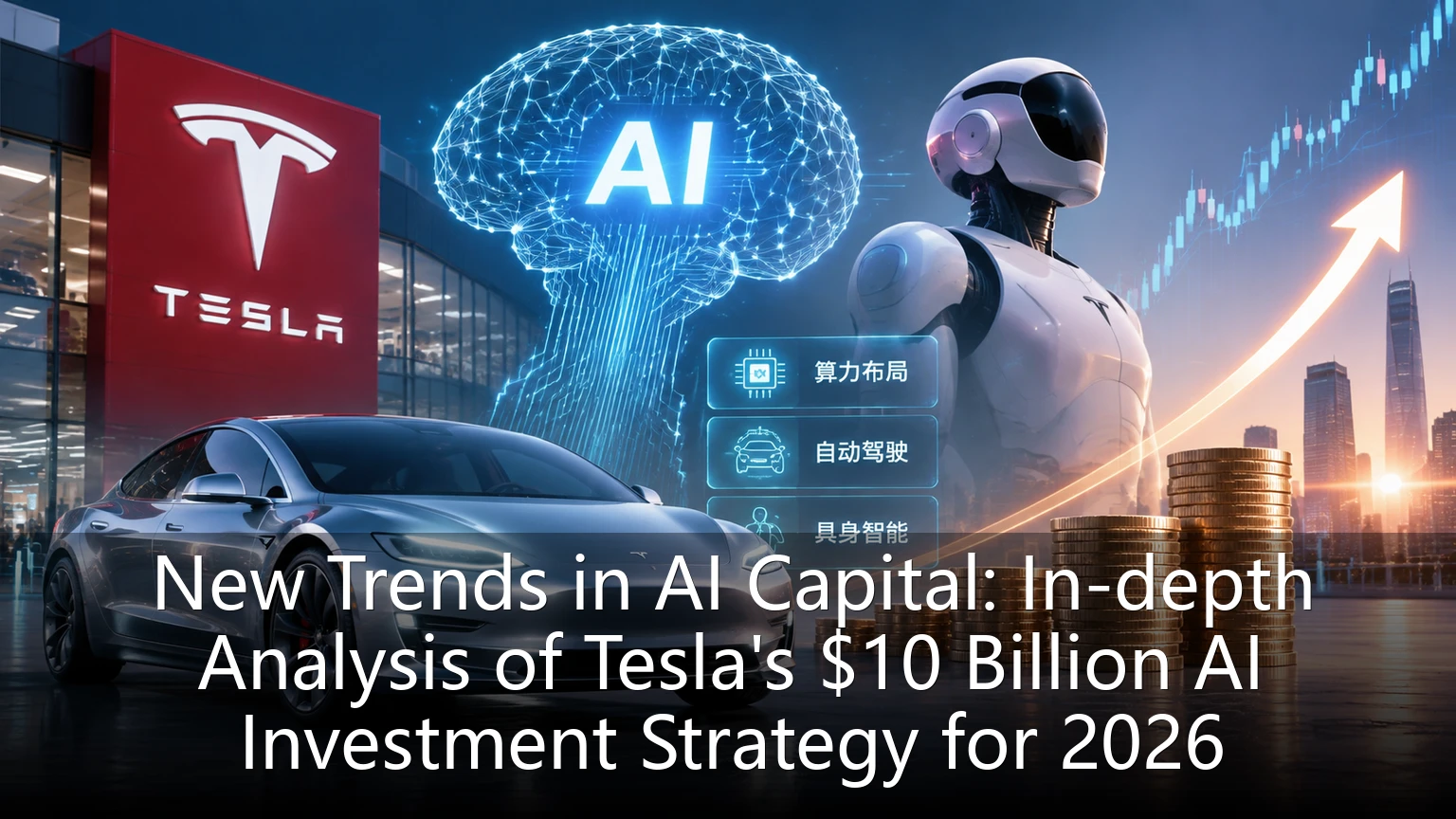
Tesla's $10 billion AI investment will focus on three core areas: autonomous driving (FSD), AI infrastructure (DOJO supercomputer), and humanoid robots (Optimus). Among them, the autonomous driving sector will receive $5 billion in investment, mainly used for FSD system iteration, data collection and annotation, and expansion of the global road test network; $3.5 billion will be invested in AI infrastructure for the expansion and optimization of the DOJO supercomputer; the remaining $1.5 billion will be injected into the Optimus humanoid robot project to accelerate commercialization.
This capital allocation reflects Tesla's clear planning for the commercialization path of AI technology. Tesla CEO Elon Musk stated in a recent investor conference call: "AI is the core engine of Tesla's future growth, and our investments will focus on areas that can generate actual commercial value, rather than simply pursuing technological breakthroughs." This strategic shift marks the transformation of Tesla's AI investment from "technology-driven" to "value-driven."
Valuation Logic Reconstruction: From Hardware Manufacturer to AI Ecosystem Platform
The deep impact of Tesla's AI capital strategy lies in the reconstruction of its valuation logic. Traditionally, as an electric vehicle manufacturer, Tesla's valuation was mainly based on traditional automotive industry indicators such as car sales and profit margins. However, with the increase in AI investment, the capital market is beginning to view Tesla as an AI ecosystem platform, and its valuation logic is shifting from traditional PE (price-to-earnings) to a mixed model of PS (price-to-sales) and PEG (price/earnings to growth).
A recent Morgan Stanley research report states: "The commercialization process of Tesla's AI business is accelerating, and its FSD system has evolved from a purely technical product to a combination of data assets and financial instruments. As the securitization process of FSD data assets advances, Tesla's valuation model will become more diversified, and the valuation contribution from AI-related businesses is expected to increase to over 60% within the next three years."
This reconstruction of valuation logic has already been reflected in Tesla's stock performance. Since 2026, Tesla's stock price has risen by 35%, with AI-related business expectations contributing more than 70%. Wall Street analysts generally believe that Tesla's AI investments are creating new valuation anchors, pushing its market capitalization to break the trillion-dollar mark.
Capital Operation Innovation: AI Asset Securitization and Financial Tool Innovation
Tesla's capital operations in the AI field show significant innovative characteristics. On one hand, Tesla is actively exploring the securitization path of AI assets. By packaging AI assets such as FSD data and autonomous driving algorithms into financial products, Tesla can monetize data assets and create new cash flow sources. According to internal sources, Tesla has partnered with multiple investment banks to prepare for issuing asset-backed securities (ABS) based on FSD data, with an expected scale of $5 billion.
On the other hand, Tesla is innovating the capital allocation model for AI investments. In the second quarter of 2026, Tesla established a $2 billion AI special venture capital fund, focusing on investing in startups in the fields of autonomous driving, AI infrastructure, and humanoid robots. This fund adopts a dual-track model of "fund of funds + direct investment," acquiring cutting-edge technology through strategic investments while generating investment returns through financial investments.
In addition, Tesla is actively exploring the REITs (Real Estate Investment Trust) path for AI infrastructure. By packaging AI infrastructure such as the DOJO supercomputer into REIT products, Tesla can achieve asset-light operations while maintaining technical control. This innovative model is expected to open up new paths in the field of AI infrastructure investment.
Market Impact and Investment Opportunities
The advancement of Tesla's AI capital strategy will have multi-dimensional impacts on the global AI industry. First, Tesla's large-scale investment will drive the coordinated development of upstream and downstream enterprises in the AI industry chain, from chip design and algorithm development to data services, and the entire AI industry chain will usher in a new round of growth opportunities. According to industry analysts, the incremental market size driven by Tesla's AI investment in the industry chain could reach $300 billion.
Second, Tesla's AI commercialization path will provide important references for the industry. The successful practice of the FSD subscription model proves that AI technology can achieve continuous cash flow through service-oriented approaches, and this model is expected to be widely applied in fields such as healthcare, finance, and industry. The accumulation of Tesla's AI commercialization experience will provide valuable lessons for other companies.
For investors, the advancement of Tesla's AI capital strategy creates new investment opportunities. In the short term, Tesla and its AI supply chain related companies will benefit from the attention of the capital market; in the medium to long term, the acceleration of the AI commercialization process will give rise to new investment targets and value growth points. Especially in fields such as AI infrastructure, autonomous driving data services, and humanoid robot commercialization, there may be investment opportunities with explosive growth potential.
Challenges and Risks
Despite the broad prospects of Tesla's AI capital strategy, it also faces multiple challenges and risks. First, AI technology research and development has high uncertainty, and changes in technical routes may lead to the sinking of previous investments. Second, the AI commercialization process may face uncertainties in regulatory policies, especially in areas such as data security and privacy protection, where policy changes may affect the commercialization process.
In addition, the advancement of Tesla's AI capital strategy needs to address the talent shortage problem. The competition for high-end talent in the AI field is increasingly fierce, and Tesla needs to build a competitive talent attraction and retention mechanism to ensure the smooth implementation of its AI strategy. Finally, large-scale AI investment will also place higher demands on Tesla's financial situation, requiring a balance between short-term investment and long-term value creation.
Future Outlook: Building and Releasing Value in the AI Ecosystem
Looking ahead, the core of Tesla's AI capital strategy lies in building a complete AI ecosystem. This ecosystem will be data-centric, algorithm-driven, and computing-power-based, realizing the unity of technical value and commercial value through the commercialization of products such as FSD and Optimus.
The construction of Tesla's AI ecosystem will go through three stages: the first stage is technology accumulation and product refinement, and Tesla is currently in this stage; the second stage is exploration and verification of business models, expected to be completed in 2027-2028; the third stage is comprehensive expansion and value release of the ecosystem, expected to enter this stage after 2029.
As Tesla's AI ecosystem gradually builds up, its valuation logic will become more complete, and the valuation contribution from AI-related businesses will continue to increase. According to predictions from multiple investment banks, by 2030, the valuation contribution of Tesla's AI business is expected to reach over 70%, becoming the main driving force for Tesla's value growth.
Overall, Tesla's $10 billion AI investment strategy for the second half of 2026 marks a key step in its transformation from a traditional automobile manufacturer to an AI technology giant. This strategy will not only reshape Tesla's own valuation logic but will also have a profound impact on the global AI industry landscape. Under the wave of AI technology commercialization, Tesla is leading a new round of development in the AI industry with its unique capital operation model and commercialization path.
For investors, closely following the progress of Tesla's AI capital strategy and grasping the opportunities and challenges in the development of the AI industry will be key to obtaining excess returns. The successful implementation of Tesla's AI capital strategy will not only create huge commercial value but will also provide important references for the commercialization path of AI technology, promoting the entire AI industry to develop in a more mature and sustainable direction.