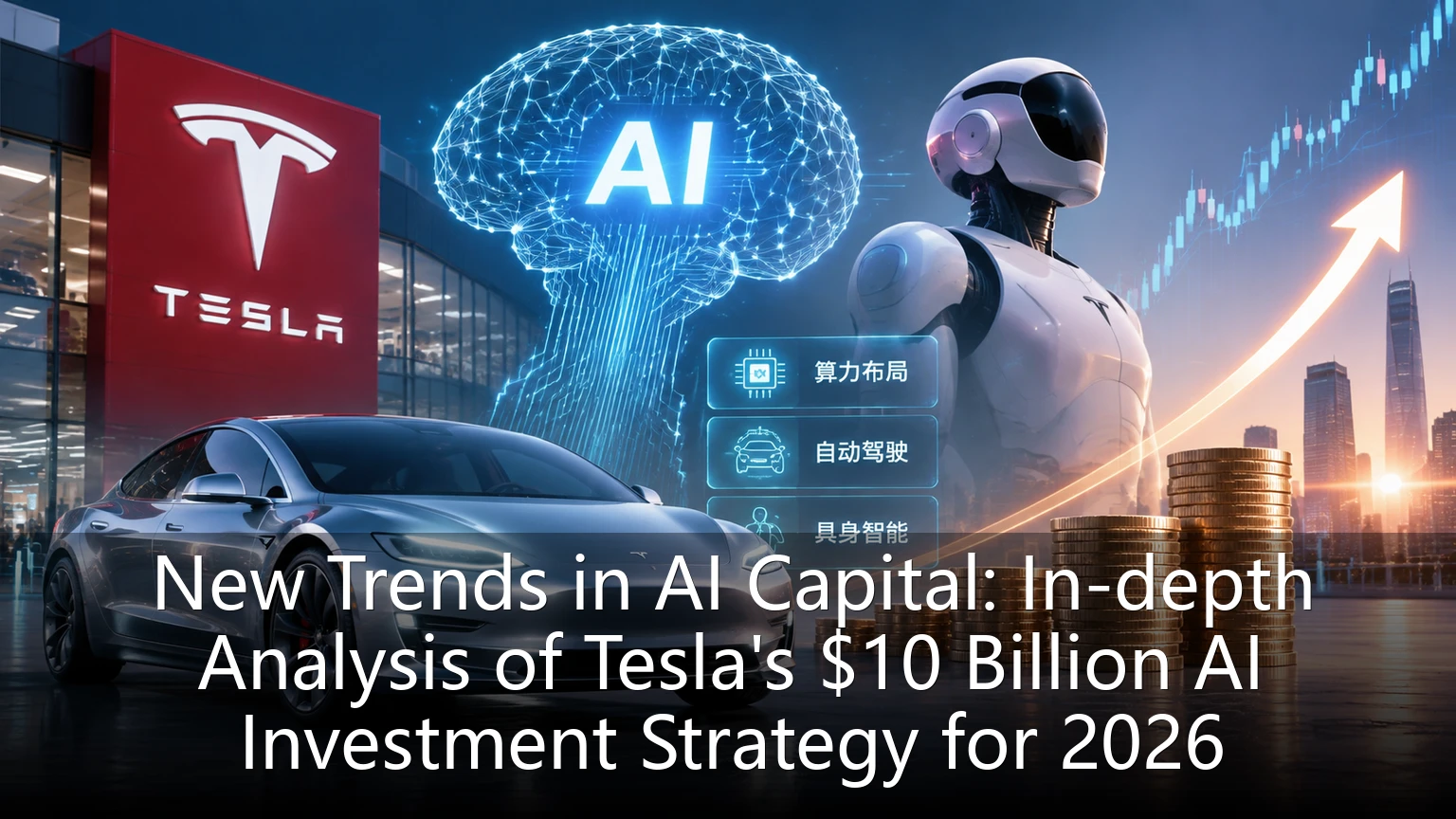
In the global capital market of Q3 2026, the valuation logic of AI enterprises is undergoing a profound paradigm shift. As large model technology moves from early parameter scale competition into the deep waters of commercialization and profit realization, Wall Street institutional investors' pricing anchor for AI assets has shifted from pure "computing power reserves and CapEx expectations" to "recurring revenue and customer lifetime value." Against this backdrop, leveraging its deep moats in autonomous driving data flywheels and AI-driven energy management, Tesla is leading an industrial revolution from hardware manufacturing to a SaaS software subscription ecosystem. This strategic transformation fundamentally alters Tesla's revenue structure and carves a new $100B valuation anchor in the AI capital barometer.
Valuation Logic Reconstruction: From Hardware Deliveries to Software Recurring Revenue
For a long time, Tesla's valuation in capital markets faced significant divergence. Traditional auto analysts favored P/E or EV/EBITDA to measure the cyclicality of its auto manufacturing, while tech and AI analysts valued the long-term option value of its autonomous driving and robotics. Entering 2026, with Tesla's Full Self-Driving (FSD) system achieving regulatory approval and surging penetration in North America, Europe, and parts of Asia-Pacific, this valuation gap is being filled by a new SaaS valuation model.
In recent institutional research and earnings previews, top investment banks note Tesla is experiencing a critical transition similar to Apple's shift from iPod to App Store services. The difference is Tesla's SaaS extends beyond cabin software to the underlying logic of mobility safety and energy asset management. The parallel of FSD monthly subscriptions and outright purchases builds a highly predictable recurring revenue pool. In traditional auto finance, a vehicle sale ends the revenue cycle, but under Tesla's SaaS model, the sale is merely the starting point for Customer Lifetime Value (LTV) development. This capital operation, converting one-time hardware sales into continuous software subscriptions, drastically smooths cash flow volatility from auto cyclicality, providing solid underlying support for Tesla's market cap management.
FSD Subscription Rate Breaking Critical Mass: A New Cornerstone for Autonomous Driving Financial Derivatives
Industry data from late Q2 2026 shows Tesla's FSD comprehensive subscription rate and outright purchase conversion rate are rapidly crossing the critical mass for commercial explosion. This breakthrough's significance to capital markets far exceeds surface revenue numbers. From a financial engineering perspective, the FSD subscription pool essentially creates a super cash flow asset for Tesla.
Wall Street quant funds have begun securitizing FSD subscription cash flows. With near-zero marginal distribution costs and underlying algorithms continuously iterating via massive shadow mode data, FSD possesses strong network effects and moat attributes. This means FSD subscription revenue not only has extremely high gross margins but also features ultra-low default rates and high renewal rates. Institutional investors view this revenue pool as high-quality underlying assets to reconstruct autonomous driving financial derivative pools. By packaging subscription cash flows from millions of owners, Tesla can unlock tens of billions in implied value on its balance sheet and use it as an anchor for low-cost financing in debt markets, further boosting CapEx in AI infrastructure like the Dojo supercomputer. This closed-loop "assetization of software subscription cash flows" is one of the most imaginative financial innovations in the AI capital market in H2 2026.
Megapack Platformization: Energy AI's SaaS Breakthrough and Revaluation
Besides autonomous driving, Tesla's SaaS breakthrough in the energy sector is equally a core engine of this valuation reconstruction. If FSD converts car hardware into software subscriptions, Megapack converts static energy storage assets into a dynamic energy AI management platform. Amidst the 2026 global energy transition, grid stability and renewable energy integration became core pain points for governments and utilities. Tesla keenly captured this, upgrading Megapack from a mere hardware energy storage battery business into an "Energy Storage as a Service" platform integrating Autobidder energy trading AI algorithms.
By charging utilities and large C&I users platform management fees based on Megapack installed capacity and dispatch revenue sharing, Tesla essentially forged a light-asset SaaS path within the heavy-asset energy storage industry. This model transforms a hardware business previously calculated by Levelized Cost of Storage (LCOS) into a fintech business based on computing power dispatch and energy trading profit sharing. Under the current AI capital barometer, this energy AI platform, featuring high-frequency trading attributes and stable return expectations, is being aggressively pursued by long-term capital seeking counter-cyclical assets. Top asset management giants like Blackstone and BlackRock are injecting billions in long-term patient capital into Megapack projects via infrastructure trust partnerships with Tesla, essentially buying SaaS dividend rights in Tesla's energy AI platform.
Deepening Sum-of-the-Parts (SOTP) Valuation: Unlocking $100B Incremental Space
As the dual SaaS ecosystems of FSD and Megapack mature, Wall Street's valuation of Tesla is fully shifting towards Sum-of-the-Parts (SOTP) valuation with more aggressive multiples. In latest valuation models, Tesla is split into four core segments: traditional auto manufacturing, FSD software subscriptions and Robotaxi mobility network, energy generation and storage AI platform, and humanoid robotics represented by Optimus.
Among these, traditional auto manufacturing, being heavy-asset and cyclical, is assigned lower P/E multiples; while FSD and the energy AI platform are benchmarked against top SaaS firms and fintech companies, assigned up to 30-50x Price-to-Sales (P/S) or more aggressive LTV multiples. This valuation system switch directly unlocks a $100B incremental valuation space for Tesla. Market analysts note that once Tesla's software and service revenue exceeds a specific threshold of total revenue, its overall P/E center will be systematically revised upward, escaping traditional automaker valuation gravity and firmly establishing its market positioning as a tech giant with dual AI infrastructure and SaaS platform attributes.
Forward-Looking Capital Strategy: Cash Flow Reinvestment and Deepening AI Infrastructure Moats
Facing the abundant free cash flow from SaaS transformation, Tesla's capital allocation strategy in H2 2026 is crucial. Musk previously hinted in investor calls that Tesla's ultimate business model is "building a robot that continuously generates cash flow and data." Whether cars or humanoid robots, their essence is data collection and execution terminals. Thus, reinvesting massive SaaS cash flows into building Dojo supercomputer clusters and R&D in synthetic data generation became Tesla's unequivocal path to consolidate its AI hegemony.
From recent financing activities and CapEx guidance, Tesla is expanding its AI computing power pool at unprecedented speed. This "internal circulation" reinvestment strategy, converting high-margin software revenue into computing power infrastructure, may temporarily squeeze free cash flow on financial statements due to massive CapEx, but from a long-cycle perspective, it is the necessary path to build an insurmountable data and computing power moat. For long-term institutional investors, Tesla's current CapEx is not a traditional capacity expansion risk, but a lock on future AI pricing power. Every doubling in computing scale means an exponential increase in its data flywheel speed, directly reflected in reduced FSD intervention miles and improved Autobidder energy trading yields.
In summary, Tesla in August 2026 is no longer a pure hardware manufacturer relying on hit model sales to drive its stock price. Guided by the AI capital barometer, it is completing a SaaS metamorphosis with FSD and Megapack as its dual wings. This leap from "selling iron" to "selling services and computing power" not only builds a high-stickiness, high-margin $100B recurring revenue pool but completely reshapes its valuation logic in global capital markets. As the AI industry shifts from concept hype to performance realization, Tesla, combining physical AI deployment capabilities with financial innovation tools, provides global investors with a highly deterministic capital safe haven and growth engine.