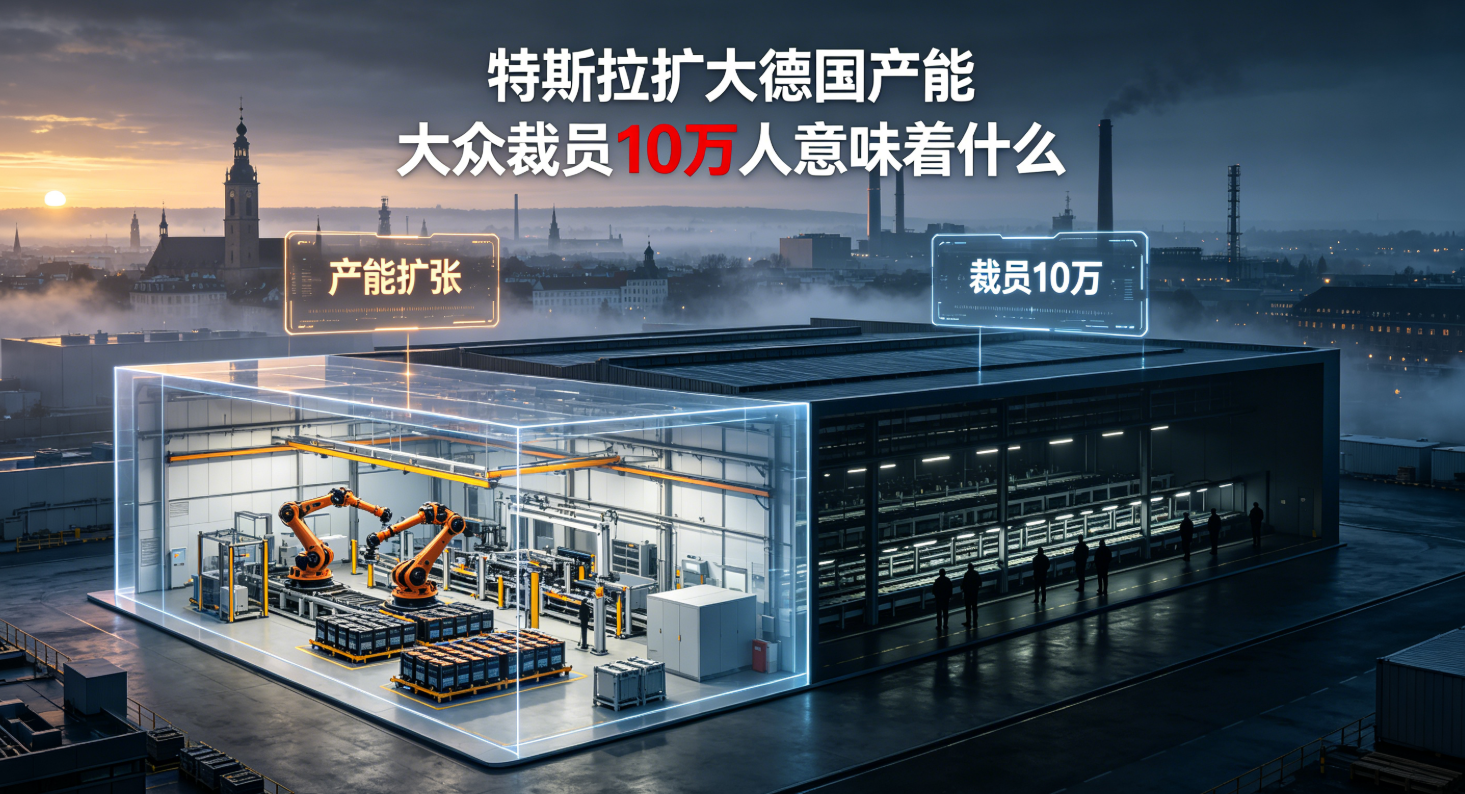
Tesla Expands Berlin Output as Volkswagen Restructures

Tesla Expands Berlin Output as Volkswagen Restructures
Summary: Tesla plans higher output at its Berlin Gigafactory as Volkswagen prepares a major restructuring, highlighting shifting EV demand and competition in Germany.
配图

Tesla Expands Berlin Output as Volkswagen Prepares Its Largest Restructuring in 89 Years

Keywords: Tesla, Berlin Gigafactory, Volkswagen, EV demand, Model Y, European automotive market, factory utilization, restructuring, Germany

Introduction

Two major developments in Germany’s automotive industry are drawing attention to the changing dynamics of Europe’s electric vehicle market. Tesla is preparing to raise production at its Berlin Gigafactory, while Volkswagen is reportedly advancing the largest restructuring in its 89-year history. Taken together, these moves reflect a sector under pressure to adjust to shifting demand, cost competition, and structural overcapacity. Yet they also reveal a more nuanced reality: signs of recovery in EV demand may be emerging, but the broader long-term outlook for Europe remains far from settled.

Tesla’s Berlin Expansion Signals a Demand Recovery

Tesla’s decision to lift weekly output at its Berlin plant to 7,500 vehicles starting in October is notable for both operational and strategic reasons. The factory will also add around 1,000 employees and convert 500 temporary workers into permanent staff, suggesting that the company sees enough demand momentum to justify a meaningful increase in capacity utilization.

The Berlin site is centered on the Model Y, for which Tesla has publicly targeted annual output of 375,000 units. Last year, the factory produced more than 200,000 vehicles, while first-quarter capacity utilization this year stood at roughly 65%. These figures indicate that the plant still has substantial room to grow. In other words, Tesla’s expansion is not a short-term push to maximize output during a brief demand spike. Rather, it appears to be a measured response to improving sales expectations for its core model.

If the recovery in Model Y demand proves durable, the economics of this move could be significant. Higher production volumes typically help spread fixed costs over more units, improving unit economics and supporting margin recovery. For a manufacturer operating in a highly competitive EV environment, this is a critical lever. Expansion, in this sense, is not only about selling more cars; it is also about lowering per-unit costs and strengthening operational resilience.

Volkswagen’s Restructuring Reflects Structural Pressure

On the other side of Germany’s auto industry, Volkswagen is preparing for a sweeping restructuring plan that could involve the elimination of 100,000 jobs and the closure of four domestic factories in Hanover, Zwickau, Emden, and Audi’s Neckarsulm site. Formal discussions are scheduled for July 9, though the final plan still requires confirmation.

The scale of this proposal underscores the depth of the challenges facing traditional automakers. Volkswagen is confronting slowing demand in key markets, intense competition in electric vehicles, and the burden of maintaining a large industrial footprint built for a different era. If implemented, the restructuring would represent one of the most consequential adjustments in the company’s long history.

Unlike Tesla’s expansion, Volkswagen’s strategy appears defensive and corrective. It reflects the need to rationalize capacity, reduce costs, and align manufacturing resources with weaker-than-expected demand. In the current environment, the ability to right-size operations is becoming as important as the ability to grow.

What This Contrast Means for the European EV Market

At first glance, Tesla’s expansion and Volkswagen’s contraction may seem to point in opposite directions. In reality, both are responses to the same underlying forces: uneven EV demand, rising cost pressure, and the need to improve efficiency.

Tesla’s move should not be interpreted as proof that the European EV market has entered a sustained growth phase. The Berlin factory still has considerable spare capacity, meaning the planned increase is best understood as an early positive signal rather than evidence of a broad, long-term market rebound. The company is responding to a likely recovery in demand for the Model Y, but this does not automatically translate into a healthier market across Europe.

That distinction matters. A single manufacturer increasing production can reflect model-specific strength, pricing adjustments, or localized demand improvement. It does not necessarily mean the entire regional market has turned a corner. For that reason, analysts should be cautious about extrapolating too much from Tesla’s decision alone.

Still, the move carries importance. It suggests that at least in some segments, EV demand may be stabilizing after a period of uncertainty. If Tesla can convert additional output into higher sales without materially weakening pricing, it would support the case that European consumers remain receptive to mainstream electric models when product value and affordability align.

The Key Indicator to Watch Next

The most important metric going forward will be new vehicle registrations in Europe, especially in Germany. Rising registrations would indicate that Tesla’s additional output can be absorbed by the market and translated into revenue. They would also help validate the company’s confidence in expanding production at Berlin.

Conversely, if registrations fail to improve meaningfully, Tesla’s extra capacity could remain underutilized, limiting the financial benefits of the expansion. In that scenario, the decision would be harder to justify, and the broader narrative of EV recovery would weaken.

For Volkswagen, the same metric will also matter in a different way. Sustained weakness in registrations would reinforce the argument for restructuring and capacity reduction. In other words, the market’s ability to absorb new EV supply will determine whether the industry’s current adjustments become a foundation for recovery or merely a response to prolonged stagnation.

Conclusion

Tesla’s planned production increase in Berlin and Volkswagen’s possible historic restructuring present two sides of the same industry transformation. One company is betting on a recovery in demand and using excess capacity to strengthen efficiency. The other is preparing to shrink its footprint to restore competitiveness. Together, they highlight an auto sector in transition, where growth is no longer assumed and operational discipline has become essential.

For now, Tesla’s expansion should be viewed as an encouraging but early signal, not definitive proof of a sustained European EV rebound. The real test lies ahead in registration data, particularly in Germany. Only if demand continues to rise will Tesla’s new capacity translate into durable revenue growth—and only then will the industry’s optimism be fully justified.

No previous article No next article